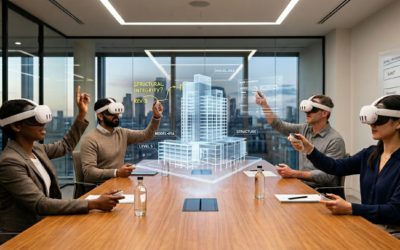

A VR classroom is a shared virtual space where students and educators meet through VR headsets, with spatial audio, collaborative tools, and the sense of being in the same room. For schools and universities, this kind of virtual classroom replaces the flat video grid with the round-table dynamics that seminars, critiques, and group work depend on.
VR education has been enterprise software since the beginning — priced for procurement teams, licensed per seat, sized for corporate budgets. Education got left out. The technology fits classrooms fine. The economics never made room.
That’s changing. raum.app’s free Education Plan opens to schools, universities, and equivalent educational institutions in June 2026. Not a trial. Not a freemium tier with the useful parts locked. A real plan for everything related to teaching, research, and student work — virtual seminars, immersive classrooms, collaborative workshops, portfolio projects, thesis work, and teacher training. Applications are open now.
The Education Plan will be available to all students and faculty members of registered schools, universities, and equivalent educational institutions.
To participate, you need a valid institutional e-mail address.
Key Takeaways
- Spatial presence: A VR classroom gives every participant a spatial position, spatial audio, and shared tools — the round-table dynamics of a physical room.
- 4x faster training: VR learners complete training up to 4x faster and are 275% more confident applying what they learned (PwC, 2022).
- Already at scale: Schools and universities already run VR education at scale: Europe’s largest VR education rollout equipped ~3,000 classrooms with headsets, the University of Miami runs 40+ XR courses, and German teacher training programs deliver immersive professional development.
- Research-backed retention: Frontiers in Education (2025) found VR produces a heightened sense of presence compared to tablets in classrooms, with high-immersion VR showing an advantage for long-term retention.
- Free for education: raum.app’s free Education Plan opens to schools, universities, and educational institutions in June 2026.
VR Education: Why It Works
Screens strip out spatial context. VR education restores it. Learning built on interaction — discussion, critique, rehearsal — needs a room with the round-table presence that makes group work feel like group work. Flat video strips away that peripheral awareness. VR puts it back.
In corporate soft-skills training — the closest large-scale data available — the evidence is clearest. A 2022 PwC study found that VR learners completed training up to 4x faster than classroom learners. They were 275% more confident to act on what they learned, and 3.75x more emotionally connected to the content. Those gains came from one thing: presence.
Recent research confirms the pattern in classroom settings. A 2025 study in Frontiers in Education compared VR headsets with iPads in the same classroom and found VR produced a measurably higher sense of presence. High-immersion VR also showed an advantage for long-term retention. The same study identified ~45 minutes as the optimal VR session length before performance starts to decline — a natural fit for a standard class period.
When learners feel inside the material, retention and confidence follow. Students in VR seminars consistently report the same effect, describing the interaction as feeling co-located with their classmates. The PwC and Frontiers data converge on the same mechanism: spatial presence drives deeper engagement, whether the learner is a corporate trainee or a university student.
The Virtual Classroom: What VR Makes Possible
Learning has always been spatial. The seminar circle, the studio critique, the lab bench, the teacher’s demonstration table — these aren’t incidental arrangements. They are how the work gets done. Remote participation compressed all of that into a box on a screen. The VR classroom restores the spatial dimension.
Consider a student joining a seminar from another city. In a virtual classroom built on VR, they take a seat at the table. They can turn toward the speaker when a point lands. They’re in the room. When two classmates start a side conversation, they can lean in. When the discussion shifts, they shift with it — present in the conversation, aware of the whole room around them.
In a design or architecture program, a student presents a project at actual scale. Critics put on their headsets and walk around the work. They can step inside the building section, move around the installation, read the site plan from above. The critique happens inside the piece, instead of describing a screenshot on a shared screen.
Distributed research teams gain something different: a shared virtual campus where the whiteboard is an object you can walk up to. A 2023 study at Vrije Universiteit Amsterdam found that 87% of master’s students in a VR collaboration described feeling present in the same space as their peers. Several said the interaction felt “like actually speaking face to face.” That quality of immersive learning is what gives VR its edge for the trust-dependent work that research groups rely on.
A cohort of trainee teachers can practise difficult classroom scenarios in a shared environment before they step in front of real students. A discussion derails, a student disengages — they work through it together. A 2025 meta-analysis in Frontiers in Virtual Reality found that immersive classroom simulations are effective for instructional rehearsal in teacher education. Immersive learning gives the rehearsal weight in a way a role-play on a flat screen never quite does.
For a full comparison of how VR collaboration compares to video calls, see how VR meetings work.
The VR Classroom: What It Actually Looks Like
Zoom is virtual. Google Classroom is virtual. Neither is spatial. A VR classroom is an entirely different thing — you are inside the room, standing in the space rather than watching through a window.
A VR headset (Meta Quest 3 or Apple Vision Pro) is what enables this. The immersive experience is built around putting on the headset.
Put on the headset. You appear at a table with your group. Spatial audio places every voice where the speaker sits — two people talking on your left sound like they are on your left. Side conversations happen without collapsing the room into a single audio channel.
A 2023 study at Ulm University (GMS Journal for Medical Education) found that VR participants spent significantly less mental effort managing the social environment than video call participants — which meant more attention on the content. That cognitive difference shows up in how the tools feel.
The whiteboard is an object in the space. Sticky notes, 3D models, annotation layers — everyone can see and handle them at the same time. In raum.app, these tools exist as shared objects with real positions, instead of screen-shared windows that one person controls. The difference is immediate.
A video thumbnail shows a face. An avatar carries presence. Turning toward a speaker is a physical gesture, rather than a UI action. You have a position in the virtual reality classroom, and that position matters — it shapes who you hear, what you see, and how the group reads your attention.
That is what “virtual classroom” means when you add VR. Not a screen with more features. A room with actual presence.
Where the VR Classroom Fits in Education
| Use Case | Institution / Program | Key Finding |
|---|---|---|
| Institutional-scale school VR | VIL/NRW initiative, Germany | ~3,000 classrooms equipped with headsets across North Rhine-Westphalia |
| International research collaboration | EU Water-Futures / KWR Water Research | 7-to-19x reduction in carbon emissions per session vs. international flights |
| Studio critiques | Design, art, and urban planning programs | Work reviewed at full scale in three dimensions |
| Distributed seminars | Reading groups and colloquia | Round-table dynamics with spatial audio and natural turn-taking |
| Professional and teacher training | University of Miami UMverse | 40+ XR courses, 1,000+ students, 350+ headsets |
| Healthcare education | Purdue University nursing | 10-15% increase on national nursing exam results |
Schools Adopting VR at Institutional Scale
Schools adopting VR at institutional scale are no longer running pilots. The VIL/NRW initiative — Europe’s largest VR education project — equipped ~3,000 classrooms across North Rhine-Westphalia with VR headsets. The NRW Ministry of Education committed a total budget of 5 million euros, distributing headsets through 46 municipal media centers. A separate “Train the Teacher” program prepared educators before the rollout completed in Q1 2025. VIL GmbH (Virtual Interactive Learning), which implemented the project, also maintains a VR content library for schools.
International Research Collaboration
International research collaboration is where the university case is clearest. Distributed teams across countries lose enormous time to travel and scheduling friction. A 2024 study published in Technological Sustainability tracked the EU Water-Futures project — a multinational initiative led by KWR Water Research Institute in the Netherlands.
Teams replaced international flights with VR meetings and recorded a 7 to 19 times reduction in carbon emissions per session, without losing the collaborative texture of in-person work. The virtual campus isn’t a metaphor here. It’s how cross-border science stays sustainable. For more on how the enterprise VR landscape is shifting, see how to get into the metaverse.
Studio Critiques in Design, Art, and Urban Planning
Studio critiques in design, art, and urban planning require spatial context. Presenting a building section, a textile installation, or a site plan on a shared screen loses the dimensional reading that gives critique its power. In a VR classroom, the work exists at scale in the room. Critics can move around it. Students can point to specific areas without saying “the thing on the left.”
Distributed Seminars and Reading Groups
Distributed seminars and reading groups need round-table dynamics: turning toward a speaker, splitting into sidebar conversations that don’t collapse the main thread. That social texture doesn’t emerge on a video grid. It does in a virtual classroom powered by VR, without anyone moderating for it.
Professional and Teacher Training Programs
Professional and teacher training programs are already scaling this. The University of Miami UMverse program runs 40+ XR courses with over 1,000 students and 350+ deployed headsets, spanning medicine, humanities, and oceanography. After Meta shut down Horizon Workrooms in February 2026, programs like UMverse became even more significant. The curriculum exists because the headset enables what flat screens cannot.
Healthcare Education
Purdue University’s nursing program reported a 10-15% increase on national nursing exam results after adopting VR and mixed reality for clinical education, according to Inside Higher Ed. When students can rehearse patient scenarios spatially, the skills transfer differently than from a textbook or video demo. That’s the pattern across healthcare VR: the body learns what the screen only shows.
VR Education Is Already Happening
Schools, universities, and professional education programs are already running immersive collaboration at real scale. This isn’t projection.
On raum.app itself, the Kunstwelten VR exhibition showed what student-led immersive learning looks like in practice. Students guided 61 visitors through an art exhibition in VR, demonstrating the platform as a space for encounters, exchange, and discussion. The format worked because VR gave the artwork and the conversation the same spatial weight.
The most telling adoption is in Germany, where teacher training programs are running VR education as immersive professional development in raum.app. Cohorts of educators work through shared scenarios as part of formal continuing education curricula. These programs adopted the platform before the Education Plan existed. That adoption convinced us to build it.
Immersive Learning and VR Training for Professional Development
Those teacher training cohorts are one example of a broader pattern. The same shared environment that lets educators rehearse difficult classroom moments works for any professional skill built on interaction — facilitation training, conflict resolution, client-facing conversations, onboarding scenarios. What connects them is simple: they require practice with other people in a shared space, instead of solo repetition on a flat screen. For how VR training fits broader enterprise adoption, see enterprise VR collaboration.
The confidence and speed gains documented in enterprise VR training apply directly here. Immersive learning works because the rehearsal feels consequential — spatial presence raises the stakes without raising the cost of failure. A facilitator can run a contentious meeting three times in one afternoon. A new hire can practise a client call with a colleague across the room, not across a chat window.
raum.app isn’t a simulation engine that scripts these scenarios. It is the room where VR training happens — spatially, collaboratively, with real people. The rehearsal works because the space does.
raum.app for Academia
raum.app is a fully-immersive VR meeting platform built for professional teams. You put on the headset and you’re in a room with your colleagues: spatial audio, shared whiteboards, 3D objects you can all handle. It is a headset-first product. That isn’t a constraint. It is the point.
raum.app’s enterprise revenue funds the Education Plan — the same platform professional teams pay for is what schools and universities get for free. The plan covers everything related to teaching, academic research, and student work: virtual seminars, immersive classrooms, collaborative workshops, portfolio projects, thesis work, research prototypes, academic publications, teacher training, and interdisciplinary collaboration. Commercial use, client work, and revenue-generating activities are excluded. Approved institutions get onboarded starting June 2026.
If you’re running lessons, seminars, studio critiques, or research collaborations and wondering whether VR education is worth the commitment, we think it is.
Applications are open. If you’re an educator or faculty member at a school, university, or equivalent educational institution, apply now for the free Education Plan. Onboarding starts June 2026.
Questions? Reach us at service@raum.app
FAQs
Is VR good for education?
VR for education depends heavily on format. For large passive lectures — content delivery to a hundred students — VR offers no clear advantage over video or a well-produced recording. For small seminars, studio critiques, research groups, and interactive classroom sessions, the case is stronger: the spatial round-table dynamic changes how discussion flows. A 2023 study at VU Amsterdam found that 87% of participants felt present in the same space as their peers, which is the foundation discussion-based learning requires. A 2025 Frontiers study confirmed that VR produces a heightened sense of presence compared to tablets, with an advantage for long-term retention. If your teaching relies on interaction rather than transmission, VR is worth a serious look.
How is VR used in education?
VR education spans several use cases across schools and universities. Seminars and reading groups use the VR classroom for round-table discussion with spatial audio and natural turn-taking. Design and architecture programs run studio critiques at full scale, with reviewers walking through student work in three dimensions. Distributed research teams hold cross-border collaboration sessions that replace international travel. Teacher training cohorts rehearse difficult classroom scenarios together in shared virtual environments. And school programs like the VIL/NRW initiative use VR headsets for interactive lessons across subjects, backed by a dedicated content library.
What is the best VR platform for schools and universities?
The right answer depends on use case and the hardware your institution can support. As a VR learning platform focused on professional and educational work, raum.app offers persistent spatial rooms, spatial audio, and collaborative tools designed for seminars, classrooms, and research sessions — with a free Education Plan for schools and universities opening in June 2026. Other platforms serve different needs: simulation-based training tools, consumer social environments, or immersive content viewers. If the goal is structured collaborative work — the kind that would otherwise happen around a table — raum.app is designed for exactly that context.
What virtual collaboration tools for students does VR offer?
Students put on a headset and enter a shared virtual space where everyone has an avatar and a spatial position. From there, the tools are practical: shared whiteboards, sticky notes, 3D model walkthroughs, and object manipulation that everyone in the room can see and interact with simultaneously. Spatial audio means side conversations happen naturally — two people can step away from the group to discuss something without disrupting the room. The headset is what makes this possible; it is the spatial experience, not a wrapper around a flat screen.
How does VR compare to Zoom for seminars?
The VR vs Zoom comparison depends on format. Large lectures and quick check-ins are where Zoom is the right tool — lower friction, no hardware needed, works on any device. For seminars where discussion dynamics matter, VR is a better fit: the spatial round-table format lets participants turn toward speakers, hold side conversations, and be accountable to the room in a way a video grid does not. A 2023 study (GMS Journal for Medical Education, Ulm University) found that VR seminar participants spent significantly less mental effort managing the social environment — which meant more attention on the content.
Is VR training more effective than classroom training?
For interactive formats, the evidence says yes. The 2022 PwC study found VR learners completed training up to 4x faster than classroom learners and were 275% more confident applying what they learned. They were also 3.75x more emotionally connected to the content. The comparison matters most for skills built on practice and interaction — facilitation, conflict resolution, client conversations — where presence raises the stakes. For passive content delivery, the advantage narrows.
What are the benefits of VR training?
The core benefits are presence, speed, and confidence. Spatial awareness makes rehearsal feel consequential — trainees practise with real colleagues in a shared space, not with a screen. VR learners train faster and retain more. Distributed teams cut travel costs and carbon emissions (one EU research consortium recorded a 7 to 19 times reduction per session). And failure is cheap: a facilitator can run a difficult meeting three times in one afternoon without any real-world consequences.
Do students need a VR headset to use raum.app?
Yes. The headset is what creates the immersive spatial experience that makes raum.app work. Without it, you have a video call; with it, you have a shared space where presence, spatial audio, and collaborative tools function as intended. For institutions choosing a VR headset for school or seminar use, Meta Quest 3 is the most accessible entry point. The headset isn’t the barrier — it is the point.
What kinds of courses and subjects benefit most from VR?
The VR in education use cases that benefit most are spatial disciplines: architecture, urban planning, design, and art programs where reviewing work in three dimensions changes the critique. Discussion-heavy formats — reading seminars, research colloquia, small-group workshops — benefit from the round-table dynamics VR enables. Teacher training programs gain from immersive classroom simulations. International collaborations where participants are spread across time zones also gain from the sense of shared presence that flat video cannot replicate. Large survey courses built around content delivery are a weaker fit; VR adds complexity without changing the learning dynamic for passive formats.
What is extended reality (XR) in education, and how does VR fit in?
Extended reality (XR) is the umbrella term for technologies that alter how people perceive and interact with their environment — virtual reality (VR), augmented reality (AR), and mixed reality (MR). In education and training, XR covers everything from AR overlays on a smartphone screen to fully immersive VR environments where users are present in a virtual space. VR is the XR modality most relevant to collaborative work: it creates a shared spatial environment where participants meet, interact, and use tools together. Schools and universities adopting extended reality in classrooms and training programs most often start with VR for seminars and collaborative sessions, and AR for individual skill practice or field-based learning.
How can my institution get early access to raum.app?
Apply for the Education Plan here. The plan is free for registered schools, universities, and equivalent educational institutions. It covers teaching, academic research, and student work — virtual seminars, workshops, portfolio projects, thesis work, research prototypes, and teacher training. Onboarding for approved institutions starts June 2026. For questions, reach us at service@raum.app.
What is immersive learning?
Immersive learning uses VR headsets to place learners inside a shared spatial environment where interaction happens through presence, not screens. Instead of watching a lecture or reading a slide, participants occupy a room together — they turn toward speakers, handle objects, write on shared surfaces, and hold side conversations that don’t disrupt the group. The evidence is strong: VR learners retain more, learn faster, and report higher confidence in applying what they learned. For schools and universities, the format fits interactive lessons, seminars, critiques, and collaborative research better than any flat-screen alternative.
What is a VR classroom?
A VR classroom is a shared virtual space where students and instructors meet using VR headsets. Unlike a video call grid, a VR classroom gives every participant a spatial position — you sit at a table, turn toward the person speaking, and use shared tools like whiteboards and 3D models that exist as objects in the room. Spatial audio makes conversation natural: two people can talk quietly without muting the room. The result is a discussion dynamic closer to being physically present than any screen-based alternative.
How is the metaverse used in education?
The metaverse in education refers to persistent virtual environments where students, educators, and researchers meet for collaborative work. Schools and universities use these spaces for interactive lessons, seminars, studio critiques, lab collaborations, and cross-campus research sessions. The University of Miami runs 40+ XR courses with over 1,000 students. In Germany, teacher training cohorts use raum.app for immersive professional development, and the VIL/NRW initiative distributed ~3,000 headsets to schools. After Meta shut down Horizon Workrooms in February 2026, the remaining platforms — including raum.app — are the ones built specifically for sustained professional and academic collaboration, not consumer social experiences.
How long should a VR session in school last?
Research suggests ~45 minutes is the optimal VR session length before performance starts to decline, according to a 2025 Frontiers in Education study. That lines up well with a standard class period. Shorter sessions of 20-30 minutes work for focused activities. The key is designing the session around active participation, not passive viewing — VR earns its value when students interact with the material and each other.