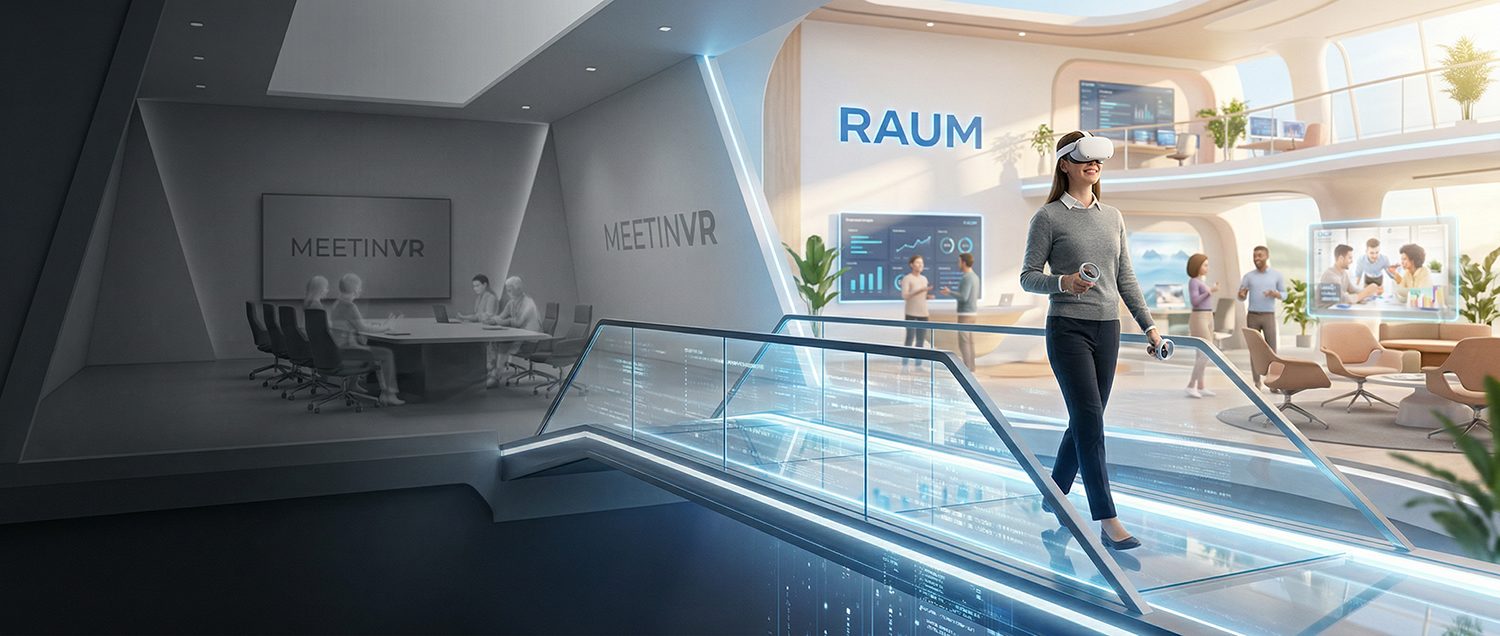
MeetInVR Is Closing on April 30, 2026: What This Means for Your Team
If your team runs VR meetings on MeetInVR, the clock is ticking. MeetInVR announced its permanent shutdown on January 29, 2026 — all services and data access end on April 30.
Unlike platforms that treated VR as an experiment, MeetInVR was purpose-built for professional spatial collaboration. That makes this closing a genuine loss. This post covers what drove the shutdown, what it signals about where enterprise VR is heading, and exactly how to migrate your team before the deadline.
What MeetInVR Announced
In its official announcement, MeetInVR confirmed that all services will cease on April 30, 2026. That date covers both the service and the data — the company has not indicated any grace period for retrieval afterward. MeetInVR described the decision as responding to “significant shifts occurring in the enterprise sector” and chose, in its words, to “finish strong.”
Users need to download all recordings, documents, and account data before the deadline. Active subscriptions will not be extended; outstanding licenses receive prorated refunds. For questions, the company directs users to support@meetinvr.com.
Why MeetInVR Is Shutting Down
MeetInVR’s announcement named three forces explicitly — and each one matters for understanding what this closure actually signals.
The first is platform realignment at the top of the industry. Meta shut down Workrooms in February 2026. Apple Vision Pro pivoted away from enterprise toward consumer spatial computing. Two of the largest players repositioned within months of each other, and that compressed the market oxygen available to smaller enterprise specialists. MeetInVR cited “key platform providers are strategically re-aligning their enterprise VR initiatives” as a direct factor.
The second is the gap between pioneering a category and scaling inside it. MeetInVR demonstrated that enterprise VR meetings work. That contribution is real. But demonstrating viability and building the infrastructure that enterprise teams actually require are different problems entirely. SSO integrations, compliance tooling, IT management, and persistent content pipelines demand sustained investment that a small, focused team could not sustain alone.
The third is capital flowing toward the next hardware cycle. MeetInVR named this directly: an acceleration in AI-enabled glasses and next-generation AR/VR is pulling investment upstream. Near-term funding is chasing the next platform, not the current one.
What this adds up to is not a verdict on the category. Enterprise VR is not collapsing — it is consolidating. The platforms without the infrastructure or focused commitment to serve enterprise teams at scale are exiting. That creates clarity, not a ceiling.
Why MeetInVR Teams Find a Home in RAUM
The MeetInVR shutdown does not close the category — it clarifies it. Enterprise teams looking for a MeetInVR alternative are not retreating from VR collaboration. They need a platform built specifically for this work, with the architecture and commitment to stay. That is what RAUM was designed for.
1. Persistent Workspaces — Work That Stays
MeetInVR was a meeting room. Sessions ended and the environment reset. RAUM is a workspace: whiteboards, 3D assets, and full content setups remain exactly where the team left them between sessions. A project in progress on Monday is still there on Thursday — no rebuild, no re-upload, no re-arrangement. For teams doing ongoing spatial work, that persistence changes everything. It is the difference between a meeting tool and a collaboration infrastructure.
2. Enterprise Security and Data Sovereignty
Data sovereignty is non-negotiable for enterprise teams — and RAUM treats it that way. European infrastructure, a closed environment, and no third-party data routing mean internal company data stays internal. For teams that hesitated on MeetInVR over data governance questions, that friction disappears at the structural level. Made in Germany means this is not a compliance checkbox ticked after the fact — it is built into the platform from the ground up.
3. Hardware Compatibility — No Fleet Replacement
MeetInVR users have already made the VR hardware investment. Quest 2, Quest 3, and Quest Pro fleets represent real budget decisions. RAUM supports the full Quest lineup alongside PCVR hardware — nothing in the existing fleet needs to be replaced. The transition from MeetInVR to RAUM is a software migration. The headsets the team already owns transfer directly.
4. A Platform Built to Last
Every MeetInVR user is now asking the same question: will this one shut down too? RAUM is independently funded and purpose-built for enterprise VR — no consumer pivot, no parent company that can shift priorities overnight. That independence is the point. The consolidation of early 2026 is clearing out platforms that lacked the infrastructure or commitment to stay. RAUM is one of those left standing.
Your MeetInVR Migration Window
The deadline is fixed. What is not fixed is how much time your team invests in a smooth MeetInVR migration. Teams that start in February or March migrate deliberately — testing workflows, transferring content, and arriving at the closure date with momentum already built. Teams that wait until April are compressing that same work into days. The deadline is identical; the experience is not.
Step 1: Download Your MeetInVR Data Now
All recordings, documents, and content stored in MeetInVR need to come out before the shutdown date. Large libraries take time to export and organize. Treat this as a week-one task, not a last-week task.
Step 2: Run Your Existing Workflows in RAUM
Replicate the specific meeting types your team runs today: recurring reviews, design workshops, onboarding sessions. RAUM’s persistent rooms mean the workspace you configure this week is still there next week — nothing resets between sessions. Start with one workflow. Book a call and the RAUM team will walk through the migration with you, including workspace setup and workflow replication.
Step 3: Commit Before April 30
Teams that decide in February or March have months of operational momentum by the time MeetInVR closes. That runway matters. Teams that wait until April are making a rushed decision under pressure, with no runway to correct it. The deadline does not move — what changes is how prepared the team is when it arrives.
FAQs
Is MeetInVR shutting down?
Yes. MeetInVR confirmed on January 29, 2026 that all services end permanently on April 30, 2026. There is no grace period for data retrieval after that date.
What is the best MeetInVR alternative?
For enterprise teams that need persistent workspaces, GDPR-native security, and full Quest hardware compatibility, RAUM is the closest match to what MeetInVR offered — with the infrastructure MeetInVR could not scale. See our full breakdown of VR meeting platforms for a broader comparison.
Can I keep my MeetInVR data after April 30?
No. MeetInVR has not indicated any data retention after the shutdown date. Download all recordings, documents, and account data before April 30, 2026.
Will my Quest headset work with other VR meeting platforms?
Yes. Quest 2, Quest 3, and Quest Pro hardware works with RAUM and other VR platforms. Your existing headset fleet does not need to be replaced.
Ready to move your team to professional VR?
- Book a call — We’ll walk through how to migrate your MeetInVR setup.